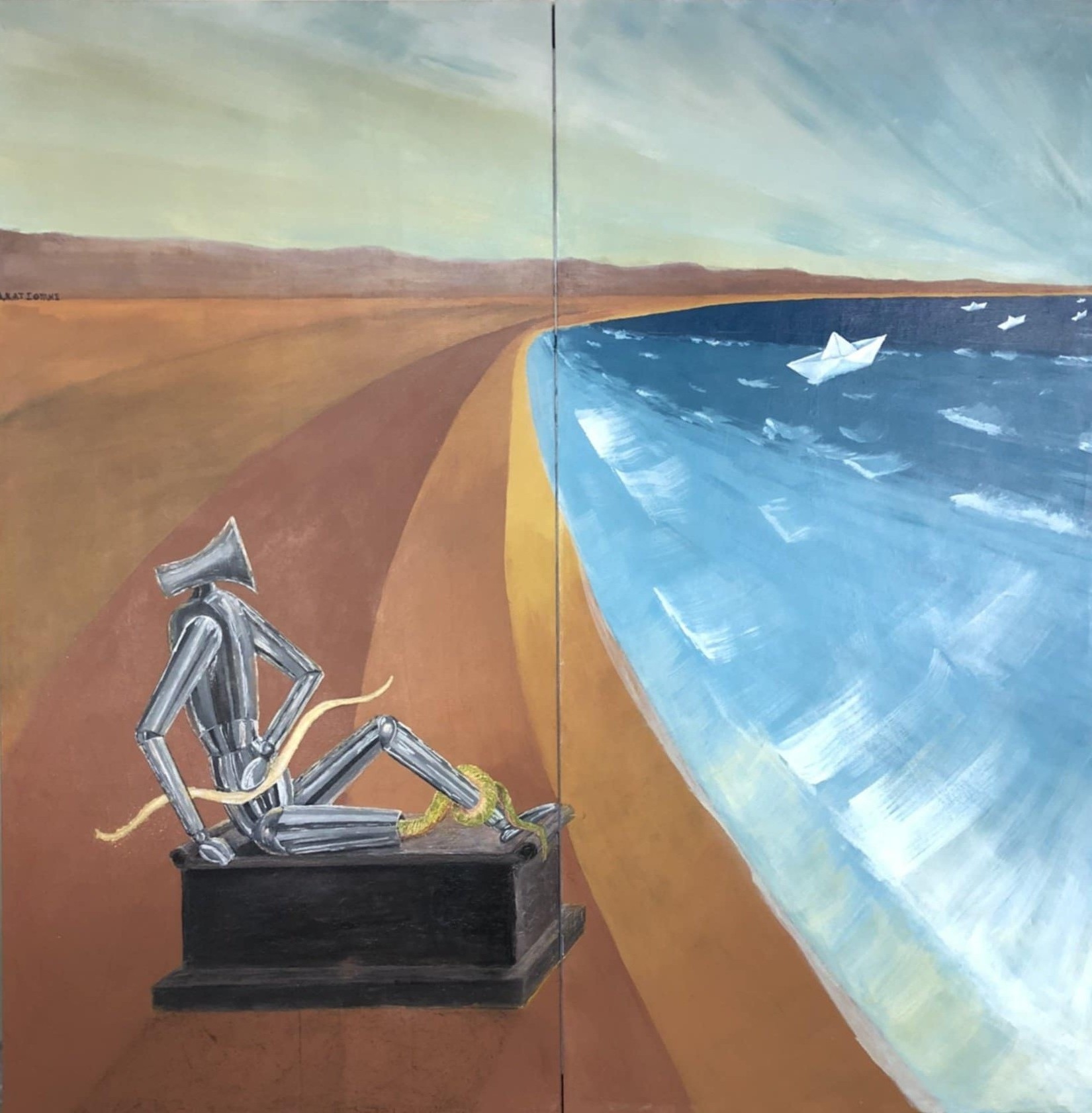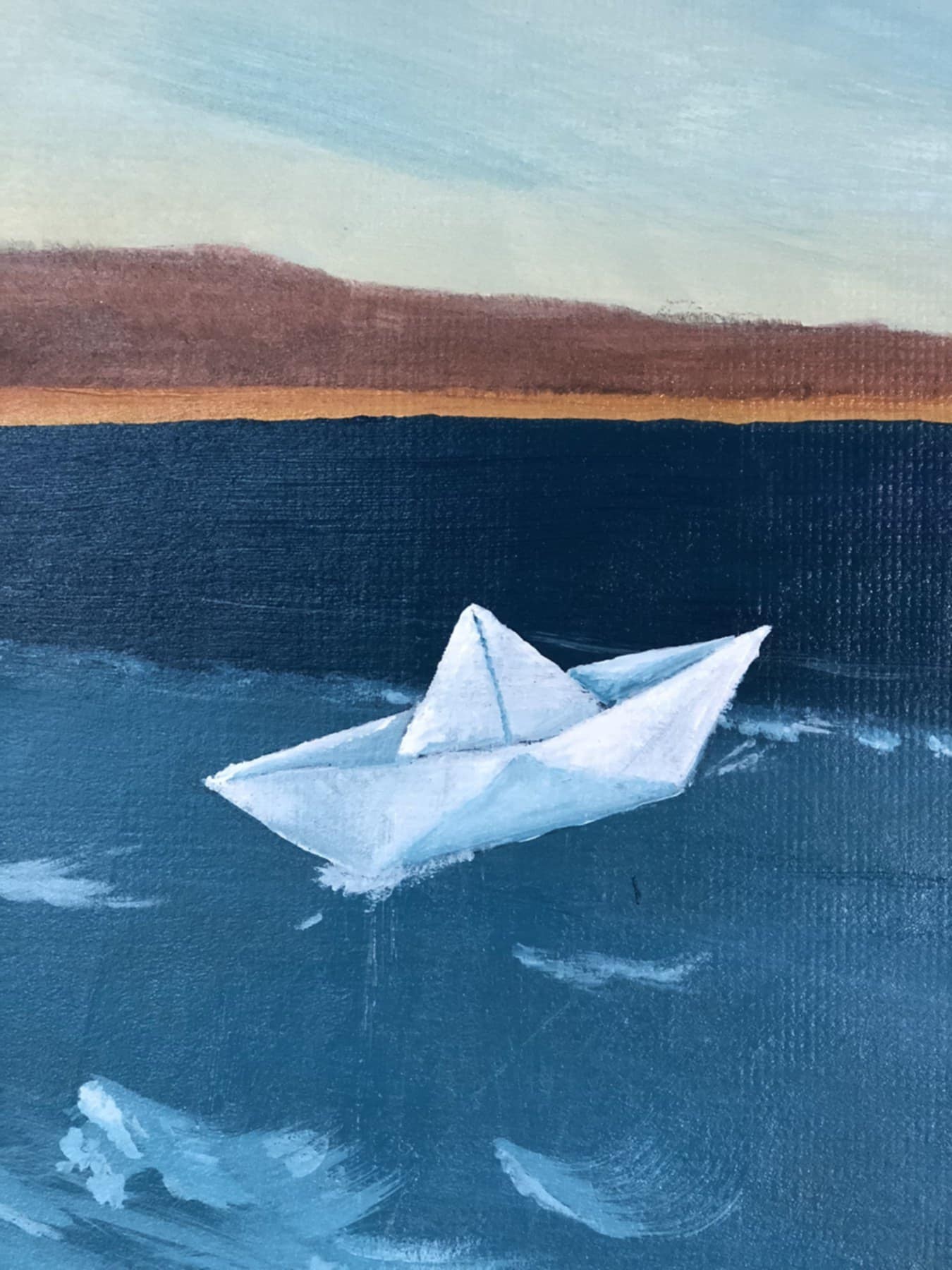
Philoctetes
Antonis Katsoulis
Acrylics on OSB surface, 250 cm x 250 cm, 2025
Listen to the artist:


Philoctetes
Antonis Katsoulis
Acrylics on OSB surface, 250 cm x 250 cm, 2025
Listen to the artist:
The myth of Philoctetes
Philoctetes, son of Poeas and Demonassa (or Methone), king of the cities of Magnesia and Thessaly, is recorded as a famous archer. Hercules left him his bow and arrows, to thank him for helping him in the laying of his funeral pyre. He is also mentioned as one of the suitors of Helen who, keeping his oath, took part in the campaign against Troy, leading a fleet of seven ships with a force of fifty archers. During a sacrifice at the altar of the nymph Chryse which was on the island of the same name near Limnos, he was bitten on the leg by a poisonous viper.
According to mythology, the viper was the goddess Hera herself, who avenged him in this way because he had helped Hercules. According to a variant of the myth, the goddess was in love with Philoctetes, but he did not reciprocate and in order to get revenge she sent him the snake. The wound became infected and bled, causing the hero unbearable pain. The Atreides, unable to endure his groaning and the stench of his wound any longer, left him helpless on the island of Limnos for ten years. With Hercules' bow he was able to survive, killing birds and prey for ten years while the Trojan War lasted and the islanders, the Siddians, tended to his ill-fated wound and soothed his pain with the healing Lemnian Earth. At the revelation of an oracle according to which Philoctetes with the bow of Heracles would contribute to the fall of Troy, the Greeks sent Odysseus and Neoptolemus, the son of Achilles, or, in other words, Diomedes, to persuade him to help by joining the war and promising that he would be healed by the children of Asclepius. Philoctetes, despite his initial objections and justified anger at being abandoned for years, was eventually persuaded to go to Troy, or according to other accounts was deceived and forced to follow the Achaeans. There he was indeed healed by Machaon, son of Asclepius. In fact, he then mortally wounded Paris with his arrow, confirming the oracle.
All three tragedians dealt with this myth with slight variations in their approach. But younger writers were also fascinated by the voice of abandonment and approached the mythical hero in their own literary way, such as André Gide, Vassilis Ziogas and Heiner Müller, confirming that literary works and mythical heroes commune amongst themselves without pause.